
NTS performs USB compliance and certification testing as licensed by the USB-IF on virtually every type of USB product. We have been authorized to perform testing of USB 2.0 and 3.0 device and systems/hubs, including SuperSpeed, high-speed, full-speed, and low-speed products. The most common cause of the Unknown USB Device (Link in Compliance Mode) is a faulty/outdated/corrupted driver on your system. Figuring out the actual cause can prove to be challenging; especially if you’re not proficient in the computer language. The use of blue pantone thermoplastics in USB 3.0 connectors is recommended on systems with a mix of USB 2.0 and USB 3.0 ports. For certification, the USB-IF does require that the user be able to clearly and easily distinguish between a USB 3.0 and a USB 2.0 port on a system; however, it is left to the system implementer on how to accomplish this.
The terms of the software license agreement included with any software you download will control your use of the software.
INTEL SOFTWARE LICENSE AGREEMENTIMPORTANT - READ BEFORE COPYING, INSTALLING OR USING.
Do not use or load this software and any associated materials (collectively,
the 'Software') until you have carefully read the following terms and
conditions. By loading or using the Software, you agree to the terms of this
Agreement. If you do not wish to so agree, do not install or use the Software.
LICENSES: Please Note:
- If you are a network administrator, the 'Site License' below shall
apply to you.
- If you are an end user, the 'Single User License' shall apply to you.
- If you are an original equipment manufacturer (OEM), the 'OEM License'
shall apply to you.
SITE LICENSE. You may copy the Software onto your organization's computers
for your organization's use, and you may make a reasonable number of
back-up copies of the Software, subject to these conditions:
1. This Software is licensed for use only in conjunction with Intel

component products. Use of the Software in conjunction with non-Intel
Usb Compliant Driver
component products is not licensed hereunder.
2. You may not copy, modify, rent, sell, distribute or transfer any part
of the Software except as provided in this Agreement, and you agree to
prevent unauthorized copying of the Software.
3. You may not reverse engineer, decompile, or disassemble the Software.
4. You may not sublicense or permit simultaneous use of the Software by
more than one user.
5. The Software may include portions offered on terms in addition to those
set out here, as set out in a license accompanying those portions.
SINGLE USER LICENSE. You may copy the Software onto a single computer for
your personal, noncommercial use, and you may make one back-up copy of the
Software, subject to these conditions:
1. This Software is licensed for use only in conjunction with Intel
component products. Use of the Software in conjunction with non-Intel
component products is not licensed hereunder.
2. You may not copy, modify, rent, sell, distribute or transfer any part
of the Software except as provided in this Agreement, and you agree to
prevent unauthorized copying of the Software.
3. You may not reverse engineer, decompile, or disassemble the Software.
4. You may not sublicense or permit simultaneous use of the Software by
more than one user.
5. The Software may include portions offered on terms in addition to those
set out here, as set out in a license accompanying those portions.
OEM LICENSE: You may reproduce and distribute the Software only as an
integral part of or incorporated in Your product or as a standalone
Software maintenance update for existing end users of Your products,
excluding any other standalone products, subject to these conditions:
1. This Software is licensed for use only in conjunction with Intel
component products. Use of the Software in conjunction with non-Intel
component products is not licensed hereunder.
2. You may not copy, modify, rent, sell, distribute or transfer any part
of the Software except as provided in this Agreement, and you agree to
prevent unauthorized copying of the Software.
3. You may not reverse engineer, decompile, or disassemble the Software.
4. You may only distribute the Software to your customers pursuant to a
written license agreement. Such license agreement may be a 'break-the-
seal' license agreement. At a minimum such license shall safeguard
Intel's ownership rights to the Software.
5. The Software may include portions offered on terms in addition to those
set out here, as set out in a license accompanying those portions.
NO OTHER RIGHTS. No rights or licenses are granted by Intel to You, expressly
or by implication, with respect to any proprietary information or patent,
Usb Compliance Driver Jobs
copyright, mask work, trademark, trade secret, or other intellectual property
right owned or controlled by Intel, except as expressly provided in this
Agreement.
OWNERSHIP OF SOFTWARE AND COPYRIGHTS. Title to all copies of the Software
remains with Intel or its suppliers. The Software is copyrighted and
protected by the laws of the United States and other countries, and
international treaty provisions. You may not remove any copyright notices
from the Software. Intel may make changes to the Software, or to items
referenced therein, at any time without notice, but is not obligated to
support or update the Software. Except as otherwise expressly provided, Intel
grants no express or implied right under Intel patents, copyrights,
trademarks, or other intellectual property rights. You may transfer the
Software only if the recipient agrees to be fully bound by these terms and if
you retain no copies of the Software.
LIMITED MEDIA WARRANTY. If the Software has been delivered by Intel on
physical media, Intel warrants the media to be free from material physical
defects for a period of ninety days after delivery by Intel. If such a defect
is found, return the media to Intel for replacement or alternate delivery of
the Software as Intel may select.
EXCLUSION OF OTHER WARRANTIES. EXCEPT AS PROVIDED ABOVE, THE SOFTWARE IS
PROVIDED 'AS IS' WITHOUT ANY EXPRESS OR IMPLIED WARRANTY OF ANY KIND
INCLUDING WARRANTIES OF MERCHANTABILITY, NONINFRINGEMENT, OR FITNESS FOR A
PARTICULAR PURPOSE. Intel does not warrant or assume responsibility for the
accuracy or completeness of any information, text, graphics, links or other
items contained within the Software.
LIMITATION OF LIABILITY. IN NO EVENT SHALL INTEL OR ITS SUPPLIERS BE LIABLE
FOR ANY DAMAGES WHATSOEVER (INCLUDING, WITHOUT LIMITATION, LOST PROFITS,
BUSINESS INTERRUPTION, OR LOST INFORMATION) ARISING OUT OF THE USE OF OR
INABILITY TO USE THE SOFTWARE, EVEN IF INTEL HAS BEEN ADVISED OF THE
POSSIBILITY OF SUCH DAMAGES. SOME JURISDICTIONS PROHIBIT EXCLUSION OR
LIMITATION OF LIABILITY FOR IMPLIED WARRANTIES OR CONSEQUENTIAL OR INCIDENTAL
DAMAGES, SO THE ABOVE LIMITATION MAY NOT APPLY TO YOU. YOU MAY ALSO HAVE
OTHER LEGAL RIGHTS THAT VARY FROM JURISDICTION TO JURISDICTION.
TERMINATION OF THIS AGREEMENT. Intel may terminate this Agreement at any time
if you violate its terms. Upon termination, you will immediately destroy the
Software or return all copies of the Software to Intel.
APPLICABLE LAWS. Claims arising under this Agreement shall be governed by the
laws of California, excluding its principles of conflict of laws and the
United Nations Convention on Contracts for the Sale of Goods. You may not
export the Software in violation of applicable export laws and regulations.
Intel is not obligated under any other agreements unless they are in writing
and signed by an authorized representative of Intel.
GOVERNMENT RESTRICTED RIGHTS. The Software is provided with 'RESTRICTED
RIGHTS.' Use, duplication, or disclosure by the Government is subject to
restrictions as set forth in FAR52.227-14 and DFAR252.227-7013 et seq. or its
successor. Use of the Software by the Government constitutes acknowledgment
of Intel's proprietary rights therein. Contractor or Manufacturer is Intel
2200 Mission College Blvd., Santa Clara, CA 95052.
Dec 21, 2020 • Filed to: USB Recovery • Proven solutions
Many users have experienced such a downfall in the quest to fully utilize their computers. It happens that sometimes, you plug a USB device but instead of functioning well, you are greeted with device request descriptor failed - pop up message. So devastating! Worry no more because that is exactly what this post is going to help you overcome.
Part 1. Overview of the Error
USB devices are important storage hubs that are used from time to time. Apart from storage, they are also a good forum for transporting files from one device to another. Talk of being small in size, easy to handle, and larger in storage capacity with numerous categories such as memory card, USB flash drive, pen drive, among others. So, you can imagine the magnitude of frustration when you encounter the device request descriptor failed at the eleventh hour into accessing a much-awaited for the file.
The USB device descriptor is the part that stores information for any of your USB gadgets. And when it fails, it means it is not able to recognize a USB device. The result is error messages such as 'one of the USB devices attached to your computer has malfunctioned, unknown USB device or tries reconnecting the device' among other baring messages.
So, what's the warning sign?
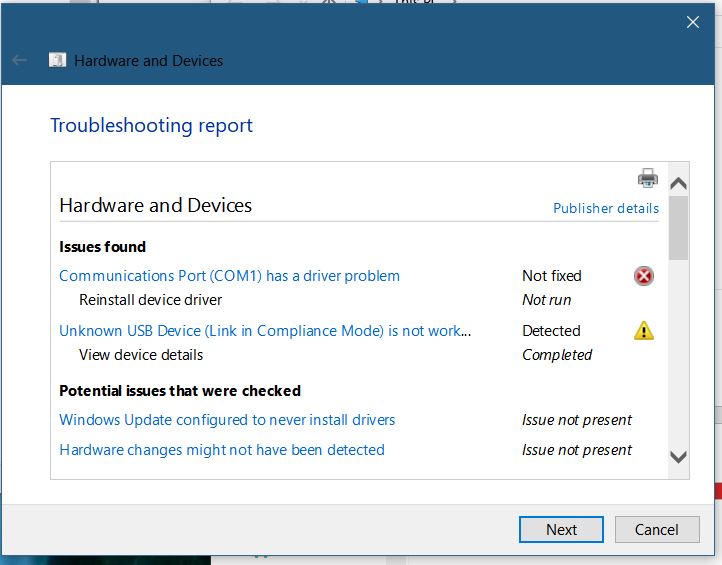
As soon as you open the 'Device Manager', you should see the USB device that's displayed under Universal Bus Controllers marked with an exclamation mark, yellow in color. Additional 'device request descriptor failed' message may also be displayed. This should be the starting point of you identifying the real problem. Check the portrayed message properties to identify the error at a point. And a plethora of causes throws you to such disarray. Check them out on our next topic!
Part 2. What Causes the 'Unknown USB Device' Error?
Several causes lead to this problem. Identifying the exact cause is the first step into helping you determine the right method to solve the issue on your Windows or other devices. Let's see how to pinpoint the root cause of unknown USB device error.
- A connection issue will result in a USB device that doesn't communicate properly with the computer. This usually reports the 'error code 43'
- Windows may also fail to find the description of your USV device
- The computer may also turn off various devices when there is a power shortage. The remedy is to disable this option in the 'Device Manager'
- If the USB device is using outdated or corrupted drivers
- If the USB drive contains bad sectors, it automatically gets damaged and will hinder further connectivity of the USB device with the computer
- Windows OS may also be missing important updates and just refuse to recognize the USB
Part 3. How Do I Fix an Unknown USB Device?
Quick Fix:
1. Try the USB device with a different USB port
In some cases, it could be that the device request descriptor failed because the USB port is malfunctioning. In such a case, you need to check each of the available USB ports individually. By this, you will be able to determine whether the problem is due to the port or not.
Plug your USB device in one port at a time. Repeat the procedure until you have tried all the USB ports. It will be easy to pinpoint which particular port has a mishap.
2. Connect the USB device to another PC
Your PC may also be the root cause of the USB descriptor failed. Possible causes may be a bad sector in the Windows OS, outdated drivers on your computer, or non-functional USB ports. Trying out another PC may help arrest the situation.
Unplug your USB device from the computer in question and connect it to another PC. If it is recognizable, then you know that the problem lies with the earlier used computer and not the USB drive.
Advanced Fix:
The first two quick fixes may not have yielded any fruit and you could be compelled to look into other solutions with in-depth performance.
1. Uninstall the USB Driver in Device Manager
This is when your computer needs a revamp probably from corrupted or outdated files. Follow these steps to uninstall the USB drive from the Device Manager.
- Open the Device Manager. Then open the 'Run dialog' box by pressing the 'Windows' and 'R' keys together. Type in 'devmgmt.msc' in the Run and then click the 'OK' button. This will open the Device Manager.
- Next, expand the category Universal Serial Bus Controllers. From the options, you can locate the USB drive that is not being recognized. It should be tagged with a yellow sign of 'Unknown USB Device' error.
- Right-click on that USB drive and choose the 'Uninstall' option. Then, restart your computer as soon as the drivers have been uninstalled successfully.
- Some Windows OS will reinstall the drivers automatically. Otherwise, you can also reinstall the drivers manually.
2. Update the USB Driver
- Go to the 'Start' menu then click on the 'Device Manager' to open the Device Manager platform.
- Next, browse and expand option 'Universal Serial Bus Controllers'
- Then right-click on the 'Generic USB Hub' entry option and select the 'Update Driver Software'
- The 'Update Driver Software Generic USB Hub' window will pop up. Check out for the driver software available for your computer. You'll be able to locate and install driver software manually.
3. Disable Fast Startup
This is another way to fix device descriptor request failed that will also prevent your USB device from powering down.
- Click the 'Start' button and then type in 'power plan'. Next, select the 'Choose a power plan' option from the results listed.
- Then click on the 'Change Plan Settings' option. Further, select the 'Change Advanced Power Settings' option.
- Expand the 'USB Settings' by clicking the box with a 'plus' sign. Once expanded, select the 'USB selective suspend settings' and pick on the 'Plugged in' option.
- Go to the drop-down menu and select the 'Disabled' option. Next, tap 'Apply' and then click on the 'OK' option. This will disable Fast Startup and help in the unknown USB device fix.
Usb Compliance Driver Training
4. Update Generic USB Hub
- To update the Generic USB Hub, go to the 'Start' menu, and select the 'Device Manager' option.
- Once the Device Manager opens, browse the available list and expand option 'Universal Serial Bus Controllers'
- Once more, right-click the 'Generic USB Hub' entry and pick on the 'Update Driver Software' option
- The Update Driver Software Generic USB Hub will pop up. Select the 'Browse my computer for driver software' option. By this, you can now locate and install the driver software manually on your computer.
- Select 'Let me pick from a list of device drivers on my computer' list option. All the driver software that is compatible with your device will be shown on the list.
- Pick the 'Generic USB Hub' item that suits your match and then click the 'Next' button. The installation will begin in due course. Wait for its completion.
Conclusion
In a nutshell, it is possible to outrightly perform a USB unknown device fix for your windows 7 or any other higher version. The above quick-fix options are simple and do not need any high-tech know-how. However, there are further advanced fixes that will dig deeper into your system and solve the unknown USB device almost instantly.
Recoverit - The Best USB Data Recovery Software
- Recovers and reads files in 1000+ file formats and restore them with 95% efficiency;
- Supports each external storage source including a USB flash drive, external hard disk, an SD card, camera, camcorder, drone, and many others;
- Available for both if your macOS & Windows devices;
- Recovers data from situations like virus-infected and crashed computer, and formatted deletion;
USB Solution
- Recover USB Drive
- Format USB Drive
- Fix/Repair USB Drive
- Know USB Drive